
Published 08/2026
Standard order sets are evidence-based medical orders for specific clinical conditions. Originated in the 1980s, use increased significantly following the introduction of computerized order entry systems.
The goals of standard order sets are to:
- Ensure that providers enter all necessary orders for patient care from admission to discharge
- Decrease variability in care by basing orders on evidence driven guidelines
- Make order entry more efficient and reduce calls for clarifications or with questions
- Reduce the potential for medication errors through alerts, hard stops, and reminders
Standard order sets are a key component in clinical care pathways and together they support efficient and effective patient care.
The team that develops a standard order set must include the physicians and others who treat the medical condition. These principles1,2 should be followed when creating standard order sets:
- Content: Standard order sets should reflect current evidence and be acceptable to a majority within the prescribing group. A standardized order set need not cover all possible scenarios but the content should be accurate and include all relevant aspects of care for the specific clinical scenario (medications, dietary orders, activity level, laboratory orders, etc.)
- Format: Standard order sets should use an easy-to-read font. Dividing these orders into sections to include admission orders, medication orders, nursing orders and procedure orders improves readability and enables providers to focus on each section as they choose between alternatives. Using only standard abbreviations and including common doses with the appropriate standard units helps minimize errors. Prompts and reminders within the order set, for example for allergies, and including orders for appropriate alternative medications, improve order efficiency, accuracy and completeness.
- Approval and Maintenance: Once standard order sets are implemented there must be a clear process for revisions and updates. It is best practice to have a single designated order set champion. This physician, nurse, or pharmacist is responsible for noting when a portion of the order set needs to be revised (e.g., new evidence emerges, guidelines change, medication shortages) and pulling together the team to revise the order set and communicate these updates with end users in a timely fashion. Out-of-date order sets should be promptly removed from in circulation.
In summary, standard order sets are a tool which if carefully crafted, periodically updated, and consistently used, enhance patient safety, and improve patient outcomes.
Example:
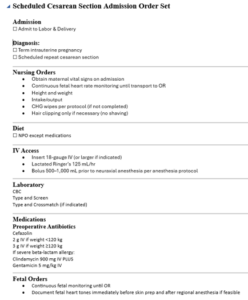
In a large academic center with 25 attending OBGYNs there was significant variation in admission orders placed prior to scheduled cesarean deliveries. This variation was contributing to delayed surgery start times, omission of critical labs, and frustration among team members. The Labor & Delivery safety committee, comprised of nurses, obstetricians, anesthesiologists and pharmacists, created an admission order set for scheduled cesarean deliveries (Figure 1) to standardize care delivery. The outcome was a sharp decline in missing orders, improvement in on-time surgery starts, and increased patient, nursing, and physician satisfaction.
Figure 1: Partial Sample Standard Order Set for Scheduled Cesarean (not complete/comprehensive):
References
1 Institute for Safe Medication Practices. ISMP’s guidelines for standard order sets [Internet]. Horsham (PA): Institute for Safe Medication Practices; 2010 [cited 2026 Jul 30]. Available from: https://www.ismp.org/sites/default/files/attachments/2018-01/StandardOrderSets.pdf
2Grissinger M. Guidelines for standard order sets. P T. 2014;39(1):10-50. PMID: 24672209. PMCID: PMC3956384.