
Published June 2026
Stakeholder analysis is a critical step when you are designing a quality improvement intervention. If the right stakeholders are not involved, it can derail your project. By engaging the right stakeholders, you mitigate many potential problems and ensure all parties have their voices heard.
To identify your stakeholders, ask:
- Who may be affected by your intervention? It’s best to cast a wide net.
- Which job types could be impacted by workflow changes or the outcome(s)?
- Who supervises the current and potential new workflows?
- Who could either help or hinder your project’s success?
- Who has final responsibility for the outcome?
- Who has the authority to carry out the work? If you do not, make sure to engage with those who have a sphere of influence over your project.
- Who pays for the work?
Internal stakeholders are employed within your organization, including nurses, physicians and advanced practice providers (APPs), technicians, staff, learners, and administrative leaders. External stakeholders are those outside of your organization, including insurance companies, external pharmacies, home-care agencies, associated providers, policymakers, and patients and their families. You should engage with ALL relevant internal stakeholders. You may not engage with all external stakeholders; however, they will influence your ability to perform your intervention. Consider their potential to positively or negatively impact your improvement efforts. Often, patients and their families will be among the most important external stakeholders. DO try to engage them.
Next, identify the issues your stakeholders care about. How will each stakeholder impact or be impacted by your proposed project? This graphic illustrates the process of identifying and engaging with them.

Common mistakes include failing to identify and engage all relevant stakeholders early in the process, not being open-minded to stakeholder input, failing to incorporate input or demonstrate input was seriously considered, and not addressing potential stakeholder conflicts.
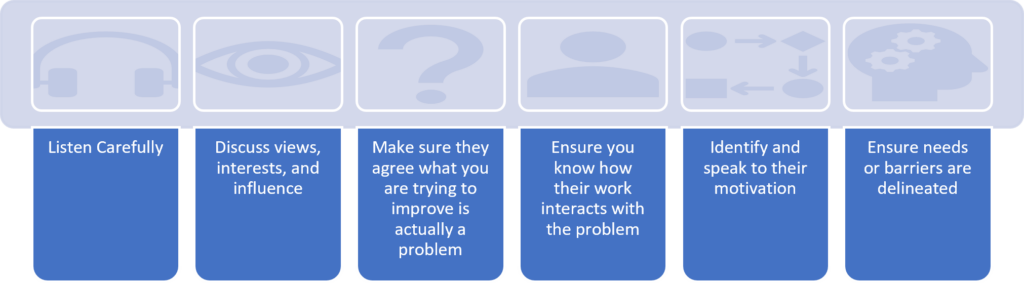
This graphic illustrates best practices for engaging with stakeholders.
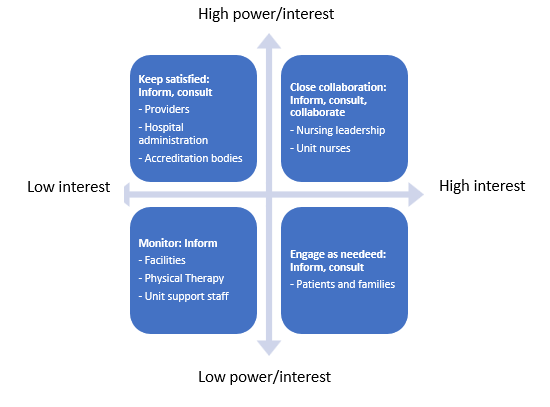
Example: A surgical floor’s quality improvement team performs a Root Cause Analysis (RCA) after a patient sustains a fall with an injury. The RCA shows identification of high fall risk patients is not consistent. You perform a Stakeholder Analysis.1 Internal stakeholders include unit nurses, nursing leadership, providers, physical therapy, facilities management, and hospital leadership. External stakeholders include patients and families, insurance companies, and accreditation organizations. Your stakeholder map is shown in Figure 1. You engage stakeholders to design door markers to indicate high-risk patients. Your intervention is implemented, decreasing the number of falls on the unit.
Figure 1: Stakeholder Map
References
1Stakeholder Analysis. Gamestorming. Accessed 5/29/26. https://gamestorming.com/stakeholder-analysis/