
Published 09/2026
Clinical care pathways originated in the United States in the 1980s. They are tools that translate evidence-based guidelines into clearly defined, easy to follow steps to optimize patient care and outcomes. The most effective clinical care pathways enable efficient, predictable care by all members of the care team. Effective clinical care pathways are narrow in their scope but broad in their impact. The medical condition selected for a clinical care pathway should be high risk, high volume, and high impact, with clear clinical guidance consistent with best practices. A clinical pathway success story is Enhanced Recovery After Surgery (ERAS), which is now the standard for perioperative care.1
Careful consideration should be given to the team that develops a clinical pathway. At a minimum, the following stakeholders should be invited to participate: clinician experts (physicians, fellows, residents, advanced practice providers (APPs), registered nurses (RNs), pharmacists, information technologists (IT) and analysts, and a clinical pathway manager.
Developing a clinical care pathway includes the following steps:
- Identifying the medical condition or disease process
- Selecting a team
- Reviewing current medical evidence and applicable society guidelines
- Identifying gaps in current care delivery or unnecessary variations in care
- Designing the clinical care pathway , with decision support tools, within the electronic medical record (EMR).
- Identifying and tracking process, balancing and outcome measures.
The success of a clinical care pathway hinges on consistent use by every member of the team. To achieve this goal, education about the pathway, including how it was created and the multidisciplinary approach to its development is important. Equally important is addressing physician and other staff members’ concerns about threats to clinical flexibility.2 This can be achieved by:
- Highlighting wins in patient care and care delivery
- Building a feedback function directly within the pathway (feedback button in the EMR)
- Including clinical pathway review as a standing agenda item at practice meetings
- Instituting “term limits” for clinician experts to allow for broad engagement
Clinical care pathways must be reviewed and updated periodically to reflect adjustments in clinical guidelines. This work should be tasked to the project manager, who will collaborate with clinician experts on medical updates. The cadence of these updates may vary based on the medical condition or disease process but should occur at least annually. Clinical care pathways should also be reviewed prior to a scheduled update if there is a significant change in clinical guidance or treatment. Compliance with specific process steps and pathway outcomes should be measured and reported.
Example:
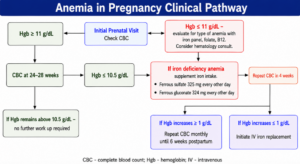
An OBGYN resident and faculty review a patient’s admission labs on Labor and Delivery (L&D) prior to her scheduled cesarean delivery. Her admission hemoglobin (Hgb) is 9.2 g/dL. They discuss anemia in pregnancy and decide to address this gap in care. The faculty member assembles a team that includes obstetricians, ambulatory APPs, ambulatory RNs, an IT manager and program manager. This team reviews societal guidelines on anemia in pregnancy and designs a clinical pathway (Figure 1) to identify patients with anemia, streamline lab and medication orders, and consult hematology if needed. The team’s goal is to reduce the number of patients with a Hgb less than 11 g/dL at the time of admission from the current 59% to 22%. The clinical pathway is presented at a department-wide meeting. Utilization is tracked and reported. At six months, updates are provided and adjustments made based on feedback. Formal review is scheduled annually and new team members are invited every two years.
Figure 1. Sample clinical pathway
References
1Stone R, Carey E, Fader AN, Fitzgerald J, Hammons L, Nensi A, Park AJ, Ricci S, Rosenfield R, Scheib S, Weston E. Enhanced Recovery and Surgical Optimization Protocol for Minimally Invasive Gynecologic Surgery: An AAGL White Paper. J Minim Invasive Gynecol. 2021 Feb;28(2):179-203. doi: 10.1016/j.jmig.2020.08.006. Epub 2020 Aug 20. PMID: 32827721.
2Every, Nathan R., Judith Hochman, Richard Becker, Steve Kopecky, and Christopher P. Cannon. “Critical pathways: a review.” Circulation 101, no. 4 (2000): 461-465.